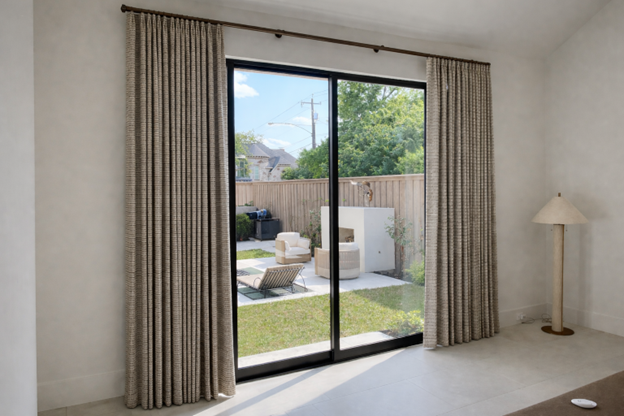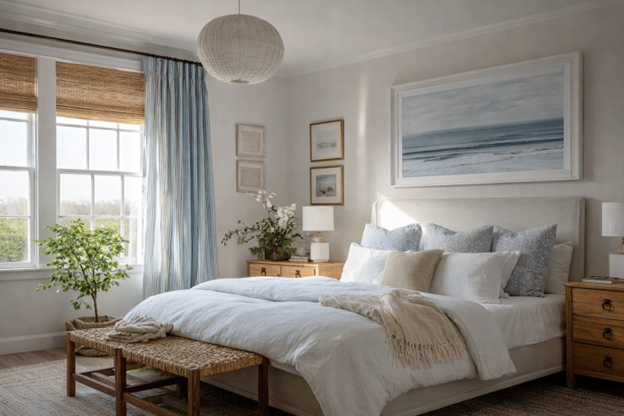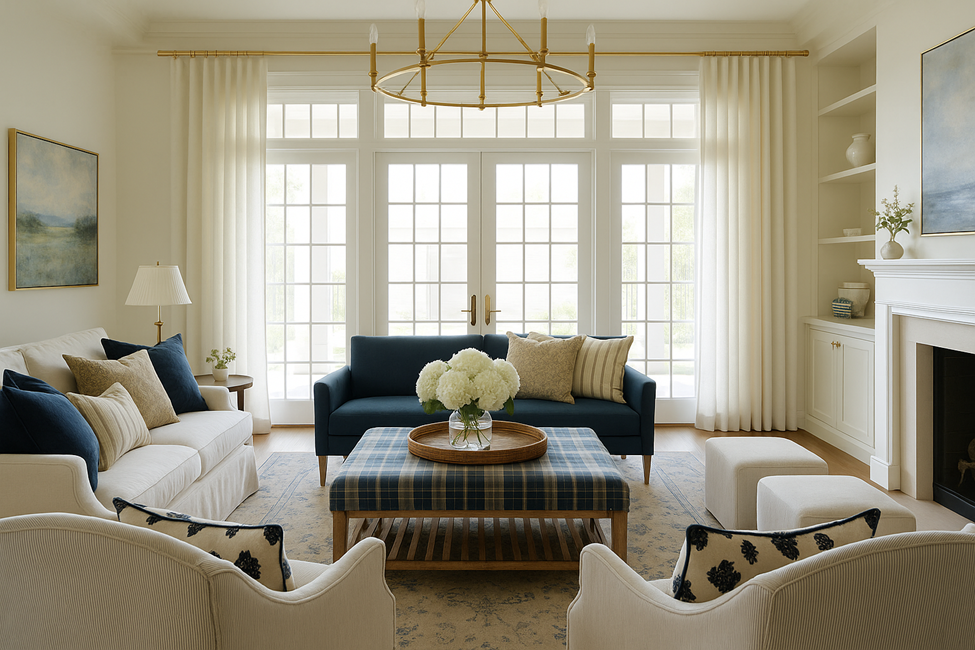
 Where design meets performance, one layer at a time
At Ross Howard Designs, we believe the most compelling spaces are those that look effortless and function flawlessly. That’s exactly why the concept of layering window treatments has become a favorite in our design toolkit — marrying form, texture and utility to create spaces that feel both curated and lived-in.
Why Layer?
Layering isn’t simply a decorative trick — it’s a strategic design move that adds depth, texture, control and intention.
- Light by day, privacy by night. A base layer (like a woven-wood or natural shade) gently filters daylight and softens the room. A secondary layer (drapery or blackout panel) gives you full control when it’s time to darken, quiet or insulate.
- Texture + contrast = dimension. Pairing materials — say, a linen drape with a woven-wood shade — adds richness to the composition. Your eye not only sees the layers, but also senses the craft.
- Performance hidden in plain sight. We’re not just dressing a window — we’re solving for solar control, acoustics, insulation, lifestyle. Layering allows us to embed functionality without compromising beauty.
- Intentional design. A layered treatment signals that no detail is accidental. From the hardware finish to the lining choice and stack-width, each decision contributes to the larger room story.
How to Build the Layer
Here’s a practical framework to execute a layered window solution that delivers both aesthetics and efficacy — a framework we often apply in our residential, commercial and industrial client projects.
1. Start with the base shade
Choose a foundational layer that addresses everyday performance: light filtering, glare reduction, modest privacy. Natural shades (bamboo, rattan, woven wood) or roller/solar shades work well. The tone and material will anchor the look.
2. Add a full-height drape or panel
Select a fabric that complements your base layer in texture and palette but stands out enough to be deliberately layered. Consider pleating style (pinch pleat, tailored pleat, box pleat), stack width, lining (privacy vs blackout), and mounting height (higher is better).
3. Choose hardware with intention
Hardware is the punctuation mark. Round it out with finishes that echo your room’s metal accents, and select return styles, finial options, and bracket stack depths that keep the drapery clear of the shade when open. The alignment of hardware and stack is crucial for a built-in, seamless look.
4. Mind the proportions & sight-lines
When layering, you want the treatments to read as a cohesive unit, not two separate pieces fighting for attention. Mount the drapery rod high and wide to give a generous frame; allow the base shade to nest behind. Ensure the stack width of the drapery doesn’t overpower the shade when drawn open.
5. Consider light, view and use case
- For rooms requiring daylight glows with privacy (dining rooms, living rooms), natural shades + drapery is ideal.
- For bedrooms or media rooms, upgrade the drapery lining or choose a blackout shade as the base layer.
- For commercial spaces where function is paramount, layering can incorporate solar control layers behind decorative drapes.
Design + Delivery: Our Approach
At Ross Howard, we handle everything from initial concept through final install — because we know that layering only succeeds when each element is aligned, measured, built and installed with precision. Here’s how we guide clients through the process:
- Discovery & visioning. We begin with the room’s architecture, light path, views, and client lifestyle. What needs to be seen? What needs to be concealed? What operations matter (motorised vs manual, maintenance, stack preferences)?
- Material selection. Leveraging your window-solutions mindset, we evaluate fabrics, shade structures, hardware finishes, mounting options and coordination with adjacent surfaces (walls, ceilings, floors).
- Fabrication & quality check. Each component is made to spec — from header construction of the drapes to the precision of the shade’s roll radius and clearance.
- Installation & alignment. Layering is only as effective as its execution. We ensure the drapery clears the shade, hardware aligns, stack width is correct, and the finished treatment appears as a unified wall-to-wall design element.
- After-care & refinement. We stand by the performance: checking operations, ensuring sight-lines remain clean, and offering detailing adjustments.
Create a Room That Does It All
When you apply layered window treatments thoughtfully, you invite softness, texture and control into a space — but you’re also engineering it for how real people live, work and move. The result is a room that looks resolved, feels comfortable, and functions exactly as needed.
Ready to master the art of layering in your next project? Let’s talk about how we can bring a fully integrated window-solution design to life — one layer, one window, one room at a time.